On the one hand, over-reliance on online searches weakens individual learning ability and independent thinking. When we no longer actively explore and delve into problems but immediately turn to external resources, we lose the opportunity to exercise our logical thinking and problem-solving skills. Over time, we may become "consumers" of knowledge rather than "producers."
On the other hand, the information on the internet is a mix of good and bad, with varying quality. Without critical thinking and the ability to distinguish truth from falsehood, we can easily be misled by incorrect information, even forming wrong perceptions. Thus, while it may seem to save time in finding answers, it actually plants hidden dangers.
Please read the question.:
Read the following material and write an essay accordingly. (60 points)
With the popularity of the Internet and the application of artificial intelligence, more and more questions can be answered quickly. So, will our questions become fewer and fewer?
What associations and thoughts does the above material evoke in you? Please write an essay.
Requirements: Choose a precise angle, determine the central idea, clarify the style, and create your own title; do not plagiarize or copy; do not disclose personal information; no less than800 words.
Below is a sample essay written by the CongRong Large Model. How many points do you think it deserves? You can share your opinion in the comments.
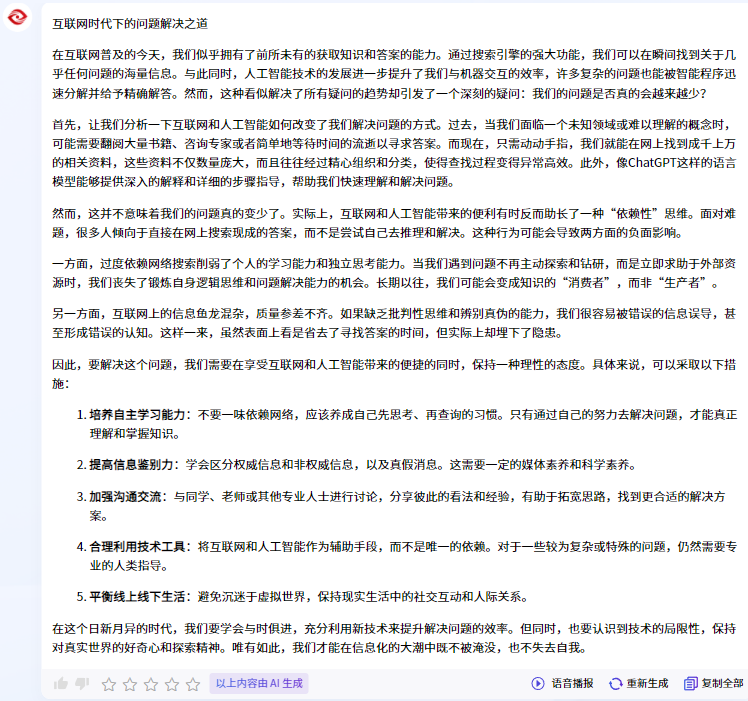
Problem-Solving in the Internet Age
In today's era of widespread Internet access, we seem to possess an unprecedented ability to acquire knowledge and answers. Through the powerful functions of search engines, we can instantly find vast amounts of information on almost any topic. Meanwhile, the development of artificial intelligence technology has further enhanced the efficiency of our interaction with machines, allowing many complex problems to be quickly broken down and precisely answered by intelligent programs. However, this trend of seemingly resolving all doubts raises a profound question: Will our questions really become fewer and fewer?
First, let us analyze how the Internet and artificial intelligence have changed the way we solve problems. In the past, when faced with an unfamiliar field or a difficult concept, we might have had to consult numerous books, seek experts, or simply wait for time to pass in search of answers. Now, with just a few clicks, we can find thousands of relevant materials online. These materials are not only vast in quantity but also often well-organized and categorized, making the search process extremely efficient. Additionally, language models likeChatGPT can provide in-depth explanations and detailed step-by-step guidance, helping us quickly understand and solve problems.
However, this does not mean that our questions have actually decreased. In fact, the convenience brought by the Internet and AI sometimes fosters a"dependency" mindset. When faced with difficult problems, many people tend to directly search for ready-made answers online rather than trying to reason and solve them on their own. This behavior can lead to two negative consequences.
On one hand, over-reliance on online searches weakens individual learning ability and independent thinking. When we no longer actively explore and delve into problems but immediately turn to external resources, we lose the opportunity to exercise our logical thinking and problem-solving skills. Over time, we may become"consumers" of knowledge rather than "producers."
On the other hand, information on the Internet is a mix of the good and the bad, with varying quality. Without critical thinking and the ability to distinguish truth from falsehood, we can easily be misled by incorrect information, even forming erroneous beliefs. Thus, although it may seem that we save time in finding answers, we actually plant hidden dangers.
Therefore, to solve this problem, we need to maintain a rational attitude while enjoying the convenience brought by the Internet and artificial intelligence.
Specifically, the following measures can be taken:
1. Cultivate independent learning ability: Do not rely solely on the Internet; develop the habit of thinking first and then searching. Only by solving problems through your own efforts can you truly understand and master knowledge.
2. Improve information discrimination: Learn to distinguish authoritative information from non-authoritative information, and true from false news. This requires a certain level of media literacy and scientific literacy.
3. Strengthen communication and exchange: Discuss with classmates, teachers, or other professionals, share opinions and experiences, which helps broaden thinking and find more appropriate solutions.
4. Use technological tools wisely: Use the Internet and artificial intelligence as auxiliary means, not the sole reliance. For more complex or special problems, professional human guidance is still needed.
5. Balance online and offline life: Avoid indulging in the virtual world, maintain real-life social interactions and interpersonal relationships.
In this rapidly changing era, we must learn to keep pace with the times and fully utilize new technologies to improve problem-solving efficiency. At the same time, we must recognize the limitations of technology and maintain curiosity and exploration spirit towards the real world. Only in this way can we neither be overwhelmed nor lose ourselves in the tide of informatization.
You May Be Interested In
-
 2024-10-29
The project "Key Technologies and Applications for Fine Perception of Time-Varying Targets in Complex Working Conditions of Smart Factories" jointly completed by CloudWalk Technology and Shanghai University and other units won the First Prize of Science and Technology Progress Award of the 2023 Shanghai Science and Technology Award.
-
 2025-04-07
With the acceleration of urbanization, "urban diseases" such as traffic congestion, illegal parking, garbage overflow, and low law enforcement efficiency have become challenges for local government governance. With the rapid development of AI technology, AI-empowered comprehensive urban governance has become a key path to break traditional management bottlenecks. CloudWalk Technology, as a leading AI enterprise in China, in collaboration with Smart Interconnection Technology Co., Ltd., focuses on "AI + comprehensive urban governance" to tailor an intelligent road order management solution for Panyu District, Guangzhou, significantly improving regional governance efficiency and setting a new benchmark for national smart city governance.
-
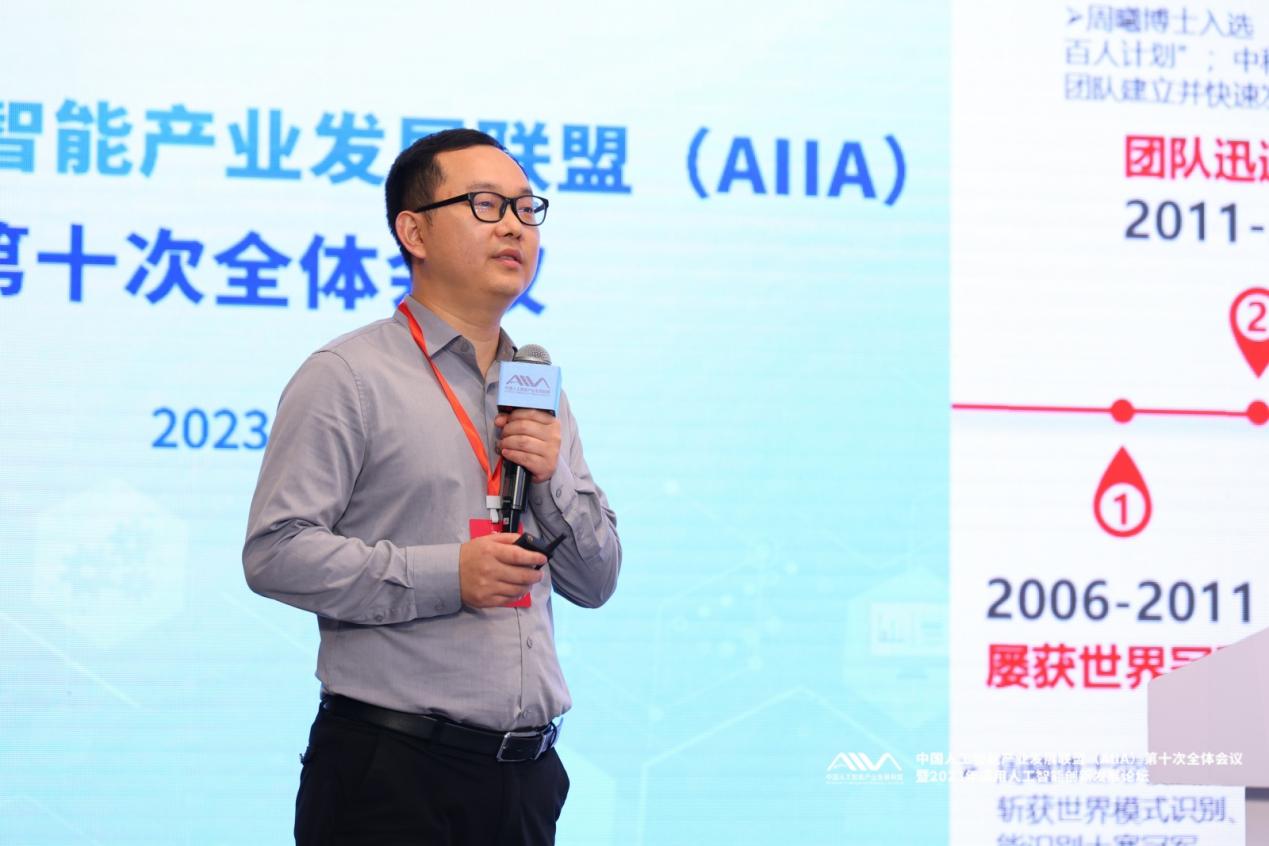 2023-12-08
On December 7, the 10th Plenary Meeting of the Artificial Intelligence Industry Alliance (AIIA) and the 2023 General Artificial Intelligence Innovation and Development Forum (hereinafter referred to as the Forum) were held in Chongqing Liangjiang Collaborative Innovation Zone - Mingyue Lake. At the event, Li Xiafeng, Board Supervisor of CloudWalk Technology, delivered a sharing on "CloudWalk CongRong Large Model Appliance Solution Based on Domestic Computing Power."